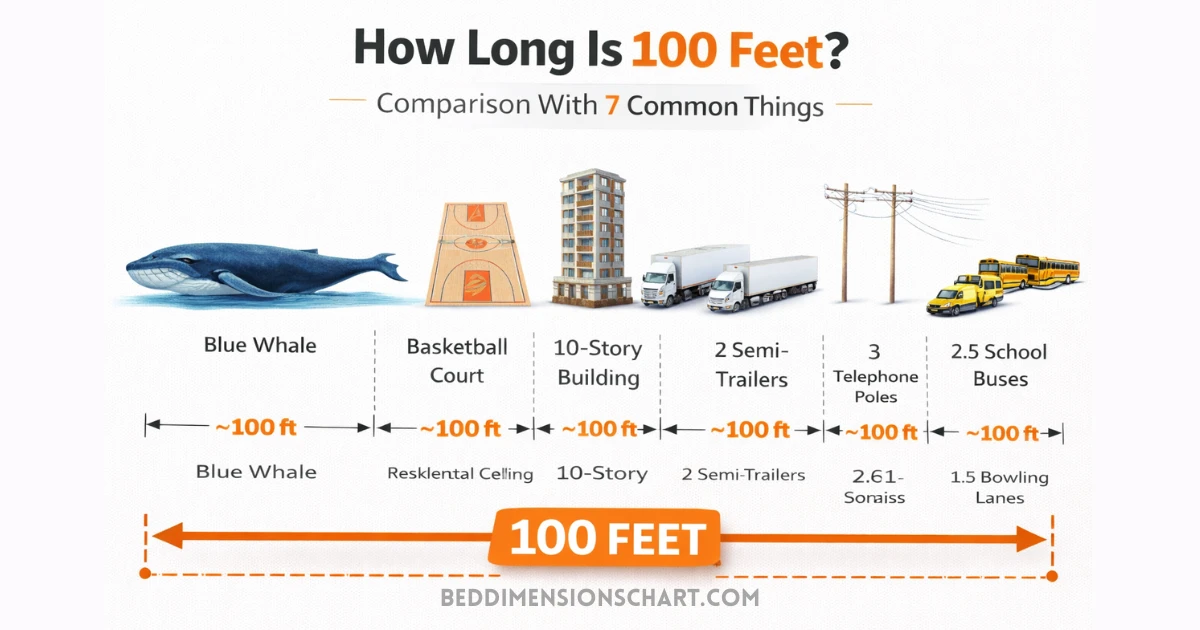
100 feet equals 30.48 meters — about the height of a 10-story building or the length of the largest animal on Earth.
Most people hear “100 feet” and draw a blank. These real-world comparisons turn that abstract number into something you can actually see, feel, and remember.
How Big Is 100 Feet (ft)?
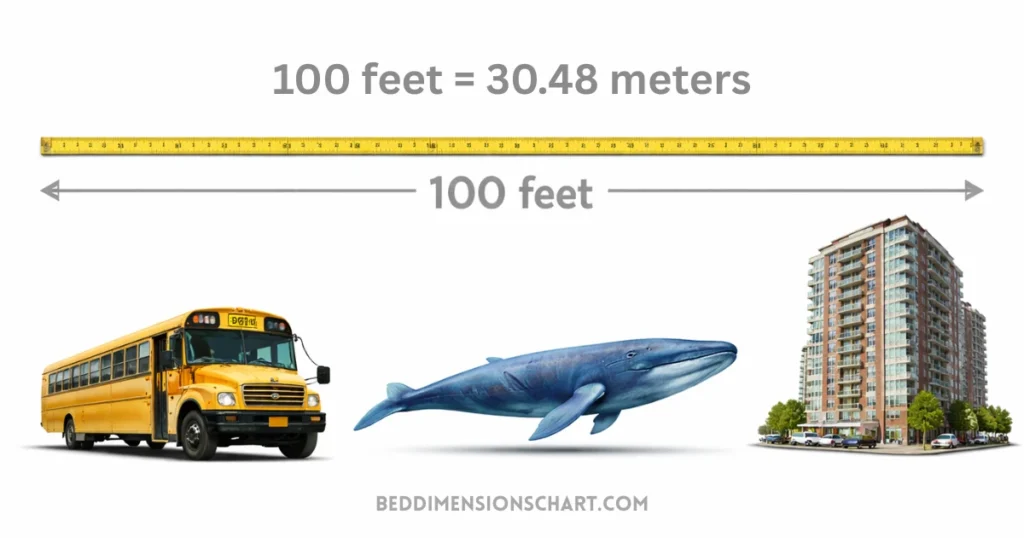
100 feet equals 30.48 meters, 1,200 inches, or 33.33 yards. On a football field, it is one-third of the total playing length from goal line to goal line.
A fast body check: the average American adult stands about 5 feet 8 inches tall. Stack roughly 17 to 18 of those adults head to toe and you reach 100 feet. That human-scale image makes this measurement feel real in seconds.
100 Feet Conversion Table
| 📏 Unit | 📐 Converted Value |
|---|---|
| Feet | 100 ft |
| Meters | 30.48 m |
| Centimeters | 3,048 cm |
| Inches | 1,200 in |
| Yards | 33.33 yd |
| Millimeters | 30,480 mm |
| Kilometers | 0.03048 km |
| Miles | 0.01894 mi |
Things That Measure 100 Feet In Length
Blue Whale

The blue whale — the largest animal to have ever existed on Earth — reaches lengths of up to 100 feet. NOAA Fisheries data confirms that the largest verified female blue whales measure between 98 and 100 feet in length.
To put that in perspective: a blue whale’s heart alone is the size of a small car, and its tongue weighs as much as an adult elephant. The entire animal stretches to 100 feet — as long as ten standard kayaks placed end to end, or the height of a 10-story building laid flat on the ocean floor.
NBA Basketball Court
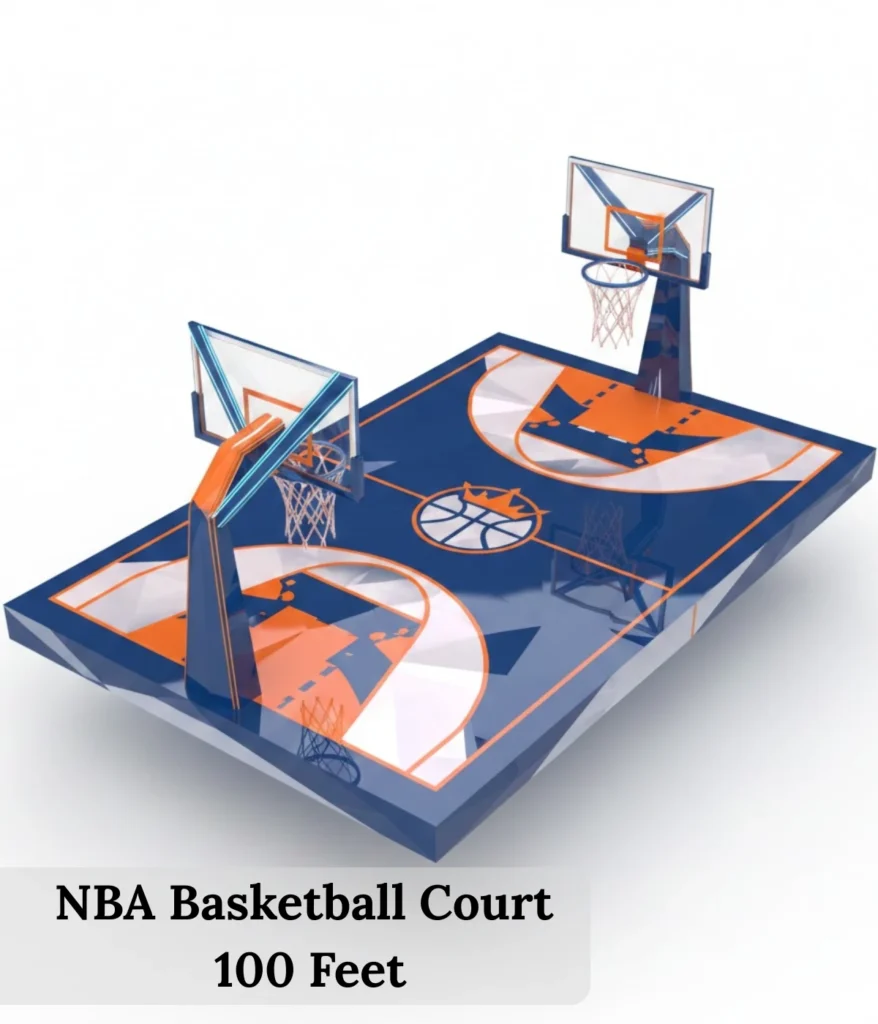
A standard NBA basketball court measures exactly 94 feet long per official league specifications. That means 100 feet is just 6 feet longer than the entire court from baseline to baseline — barely past the out-of-bounds line on either end.
How much is 100 feet visually in a sports setting? Walk into any NBA arena or college gymnasium, stand at one baseline, and look to the opposite end. Then mentally extend that view by just one more step past the far baseline. That full distance is 100 feet.
Ten-Story Building

At the standard 10-foot floor height set by the International Building Code (IBC), ten floors stacked equals exactly 100 feet from ground to roofline.
How tall is a 100-foot building? It’s a 10-story structure — the kind that defines mid-rise neighborhoods in cities like Denver, Nashville, and Austin. Stand at the base of any 10-story building and tilt your head straight up to the roofline. That full vertical distance looking back down is exactly 100 feet.
Two Semi-Truck Trailers

A standard US semi-trailer — the most common freight trailer on American highways — measures exactly 53 feet in length under Federal Motor Carrier Safety Administration (FMCSA) regulations. Two 53-foot trailers placed end to end reach 106 feet — just over our 100-foot target.
For a closer approximation: a 48-foot trailer (the second most common US length) plus a standard tractor cab of approximately 20 feet totals close to 100 feet for a single complete truck unit. Every time an 18-wheeler rolls past you on the highway, you are watching a vehicle that stretches approximately 100 feet from front bumper to rear doors.
Three Telephone Poles

The National Electrical Safety Code (NESC) sets standard utility pole height at approximately 35 feet above ground after installation. Lay three of those poles end-to-end on the ground and the total reaches roughly 105 feet — just slightly over 100 feet.
Look at any three telephone poles running along your street. Mentally tip them over and lay them flat in a straight line. That row of wooden poles stretching across the pavement covers almost exactly 100 feet — a surprisingly vivid way to picture this distance from any American sidewalk.
Two and a Half School Buses

A full-size American school bus measures approximately 40 feet in length. Park two and a half buses bumper-to-bumper — two full buses plus half of a third — and the total hits exactly 100 feet.
How many school buses equal 100 feet? Exactly two and a half. Picture two full yellow school buses parked end-to-end on your street. Then add half of a third bus behind them. That extended line of yellow steel stretching down the block is your 100-foot reference in the most American setting possible.
One and a Half Bowling Lanes

Most people think a bowling lane is 100 feet long — but the actual playing surface from foul line to headpin is only 60 feet. The full 100-foot measurement includes the bowler’s approach area (approximately 15 feet), the playing lane (60 feet), and the pin deck and mechanical pit at the rear (approximately 25 feet).
The United States Bowling Congress (USBC) specifies the total lane structure — from the very back of the approach to the end of the pin-setting machinery — at close to 100 feet in total length. This is why bowling alleys feel long from end to end — you are standing at one end of a nearly 100-foot structure.
100 Feet Appears in Real Life (USA)
100 feet defines American infrastructure, nature, and safety regulations in ways most people never realize.
Building codes & safety — The IBC and IRC use 100 feet as a key threshold for high-rise classification, aerial ladder access requirements, and sprinkler mandates.
Transportation — The Federal Highway Administration designs Interstate on-ramps with a minimum of 100 feet of taper length. Standard railroad freight cars measure 50 to 60 feet, meaning two cars end to end approach 100 feet.
Sports & recreation — The NBA basketball court measures 94 feet — adding standard safety buffer zones brings a typical gymnasium to 100 feet from wall to wall.
Nature & forestry — The US Forest Service identifies 100 feet as the average canopy height of old-growth Eastern hardwood forests.
Marine & boating — A 100-foot megayacht is the entry-level size classification for US Coast Guard super-yacht regulations, triggering different licensing, crew, and safety equipment requirements than smaller vessels.
How To Visualize 100 Feet Without a Tape Measure
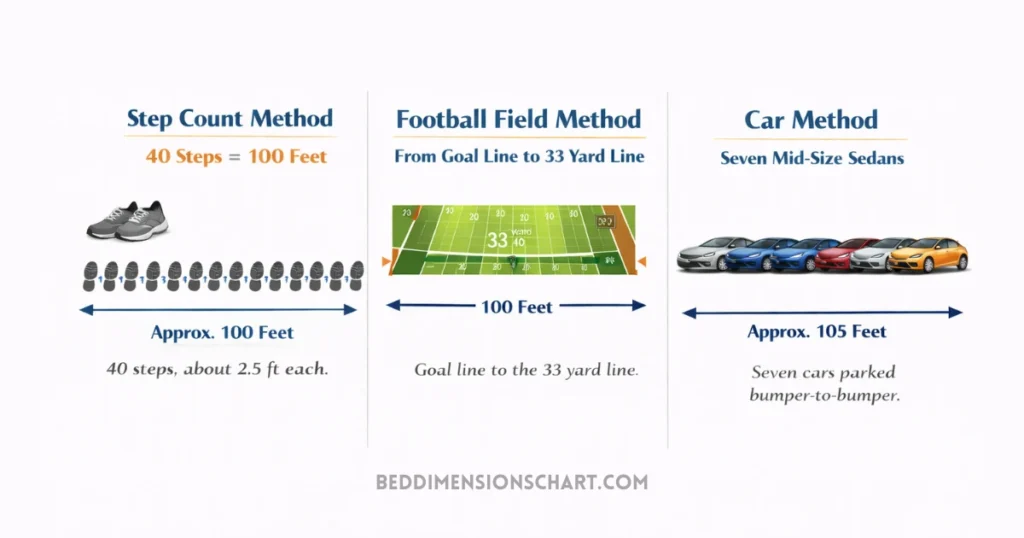
No measuring tape? These practical methods work anywhere in the US.
Count your steps. An average adult walking step covers approximately 2.5 feet. Take 40 steady paces in a straight line and you have covered almost exactly 100 feet — the same technique used by urban planners on preliminary site visits.
Look at a 10-story building. Count ten floors on any apartment or office building near you. That roofline is 100 feet above the ground — a reference you can spot from blocks away.
Picture a school bus times 2.5. A full-size school bus is approximately 40 feet long. Two and a half school buses placed end to end equal 100 feet — an easy mental calculation using one of America’s most recognizable vehicles.
Use an 8-lane highway. Stand on any overpass and look down at 8 lanes of traffic. The total driving surface width is approximately 96 to 100 feet — one of the most vivid and surprising horizontal references available.
Use a fire truck ladder. A fully extended aerial ladder on any city fire truck reaches 100 feet. If you ever see a fire department training exercise with a raised ladder, you are watching 100 feet demonstrated in real time.
Frequently Asked Questions
How long is 100 feet?
100 feet = 30.48 meters = 1,200 inches = 33.33 yards — exactly one-third of a standard NFL football field from goal line to goal line.
How much is 100 feet visually?
It looks like a full NBA basketball court plus 6 feet, a 10-story building, two and a half school buses end-to-end, or a full-grown blue whale at maximum adult length.
What is equivalent to 100 feet?
A blue whale at full length, a 10-story building, two semi-truck trailers end-to-end, or two and a half full-size school buses parked bumper-to-bumper.
How many car lengths is 100 feet?
Approximately 6 to 7 average mid-size sedans parked bumper-to-bumper — each running about 14 to 15 feet in length.
How many school buses equal 100 feet?
Exactly two and a half full-size school buses — each measuring approximately 40 feet — parked end-to-end in a straight line.
How far is 100 feet to walk?
At a normal walking pace, 100 feet takes roughly 20 to 30 seconds — about 40 average walking strides for a typical American adult.
How long is 100 feet in miles?
100 feet = exactly 0.01894 miles — roughly one-fiftieth of a single mile on any American road or highway.
How tall is a 100-foot building?
A 100-foot building stands 10 stories tall at the standard 10-foot floor height per the International Building Code — a classic mid-rise structure found in city neighborhoods across America.
Conclusion
100 feet — 30.48 meters — is the scale at which ordinary life becomes genuinely impressive. It is the height your city’s fire trucks are built to reach, the length of the ocean’s largest creature, the width of the highway you drive on, and the roofline of the building you pass every morning.
Once you connect this distance to things you already know — a blue whale, a 10-story building, a fire truck ladder, or 40 walking steps — you will never need a tape measure to picture 100 feet again.

Hi, I’m John Smith, the admin at BedDimensionsChart.com. I make measurements simple and easy to understand, from bed sizes to everyday length conversions. Clear guides. Accurate dimensions. No confusion.