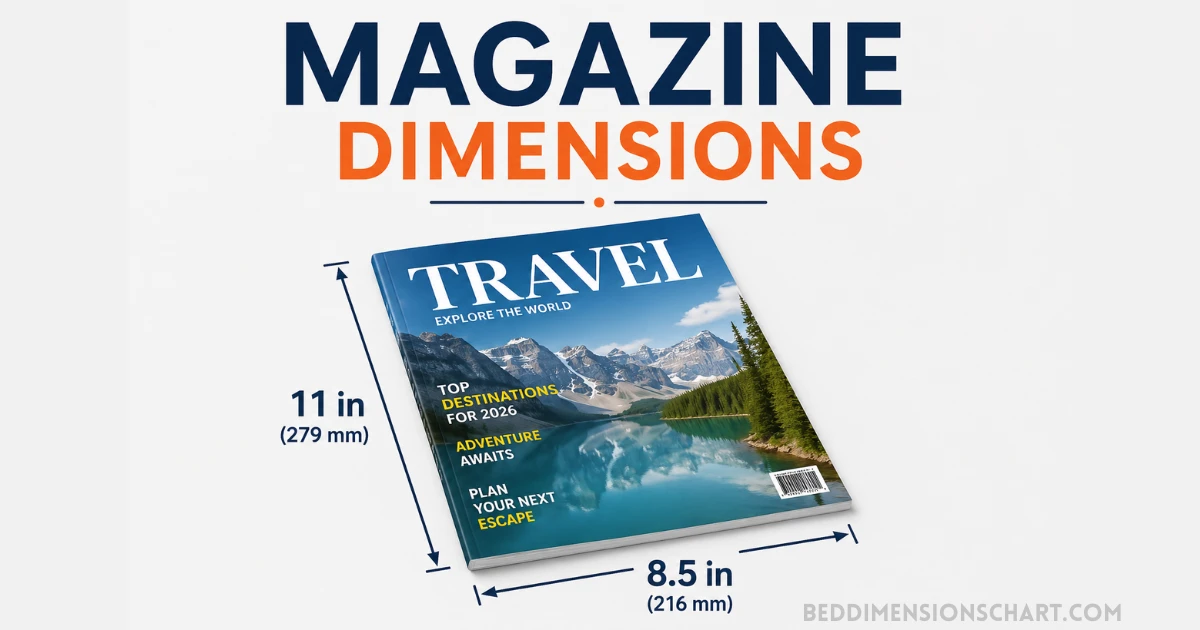
A standard magazine measures 8.5 × 11 inches (216 × 279 mm) in the USA — matching letter paper size for maximum printing efficiency. About 60–70% of American consumer magazines use this format because it reduces waste and fits standard equipment perfectly.
From compact digest formats to oversized premium publications — this guide covers every magazine dimension, binding type, and production spec you need.
Standard Magazine Dimensions in the USA
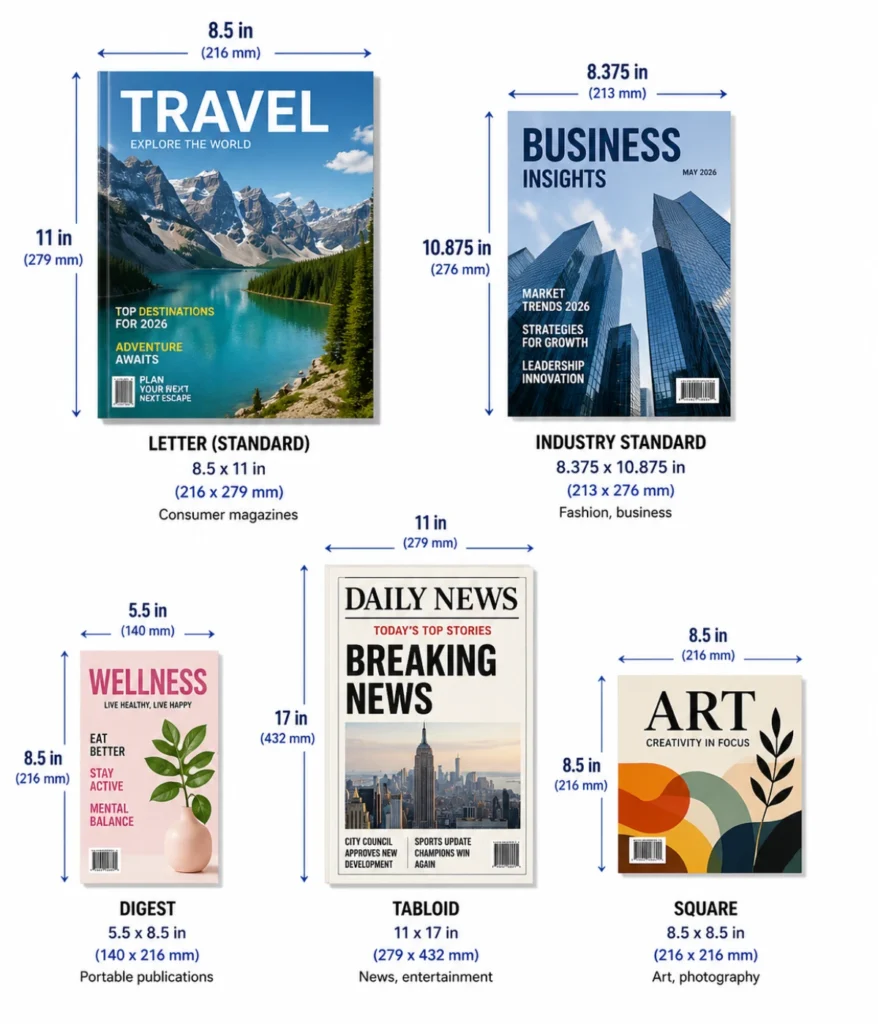
American publishers rely on three primary magazine sizes. Each format serves different content needs, audience types, and budget requirements.
The letter size (8.5 × 11 inches) is the dominant format. Time, People, and Cosmopolitan all use these exact dimensions. It provides ample space for photography, editorial content, and advertising — while keeping production costs low since it matches standard office paper.
| Format | Width | Height | Metric | Common Use |
|---|---|---|---|---|
| Letter (Standard) | 8.5 in | 11 in | 216 × 279 mm | Consumer magazines |
| Industry Standard | 8.375 in | 10.875 in | 213 × 276 mm | Fashion, business |
| Digest | 5.5 in | 8.5 in | 140 × 216 mm | Portable publications |
| Tabloid | 11 in | 17 in | 279 × 432 mm | News, entertainment |
| Square | 8.5 in | 8.5 in | 216 × 216 mm | Art, photography |
The 8.375 × 10.875 inch industry standard is the actual trim size used by major publishers like Vogue, National Geographic, and Time — slightly smaller than full letter size to allow for bleed and cutting tolerance.
Magazine Height and Width Variations Explained
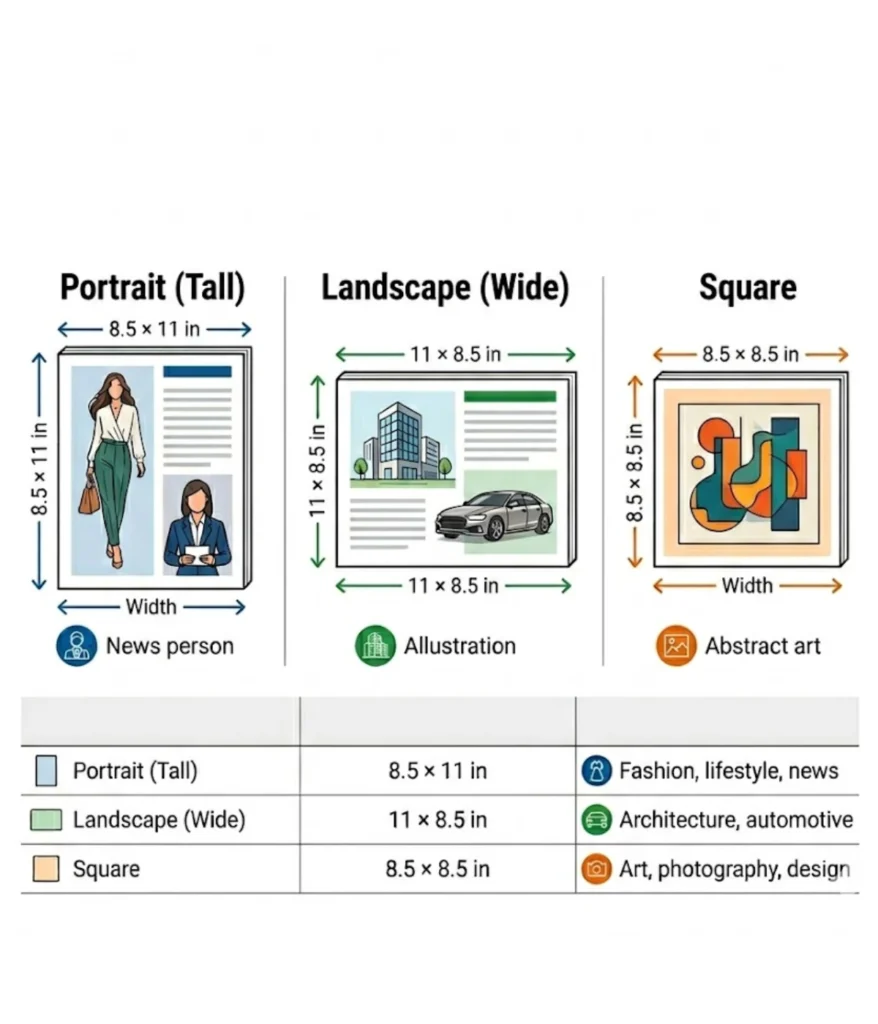
Portrait, landscape, and square formats each serve different publishing goals. Choosing the right orientation helps improve readability, visual impact, and overall reader engagement.
Portrait formats are popular for fashion and lifestyle magazines, landscape layouts suit wide photography and panoramic content, and square formats are commonly used in art and design publications for their balanced appearance.
| Orientation | Typical Dimensions | Best Content Type |
|---|---|---|
| Portrait (Tall) | 8.5 × 11 in | Fashion, lifestyle, news |
| Landscape (Wide) | 11 × 8.5 in | Architecture, automotive |
| Square | 8.5 × 8.5 in | Art, photography, design |
Specialized Magazine Sizes and Custom Dimensions
Custom magazine sizes help publications stand out and create a unique brand identity. Non-standard dimensions are often used to give magazines a more premium look and feel.
Oversized formats are popular in fashion, architecture, and art publications, while pocket-sized magazines prioritize portability and concise content, making them ideal for travel guides, mini zines, and specialty publications.
| Format Type | Dimensions | Production Cost | Best For |
|---|---|---|---|
| Oversized | 9 × 12 in + | +50–70% | Luxury fashion, fine art |
| 3.5 × 5 to 4 × 6 in | −30% | Travel guides, zines | |
| Square | 8.5 × 8.5 in | +15% | Art, creative professionals |
US vs International Magazine Dimensions
American and European magazine formats don’t align — the USA uses imperial letter dimensions while Europe follows the metric A-series paper system.
A4 (8.27 × 11.69 inches) is the standard magazine and document size across much of the world, while A5 (5.83 × 8.27 inches) is a smaller, portable format commonly used for booklets and compact publications.
One advantage of the A-series system is that each size is created by folding the next larger size in half, making it highly efficient for printing and paper use.
| Format | Width (in) | Height (in) | Metric | Region |
|---|---|---|---|---|
| US Letter | 8.5 | 11 | 216 × 279 mm | USA |
| A4 | 8.27 | 11.69 | 210 × 297 mm | Europe / International |
| US Digest | 5.5 | 8.5 | 140 × 216 mm | USA |
| A5 | 5.83 | 8.27 | 148 × 210 mm | Europe / International |
International publishers distributing in the USA often adapt to US letter dimensions to avoid custom paper orders and reduce printing costs.
Magazine Binding Types and Their Impact on Dimensions
Binding method directly affects thickness, durability, and page capacity — and each method requires specific dimension planning before going to print.
Saddle stitch binding uses metal staples through the spine fold — works for 8 to 92 pages and adds minimal thickness. A 48-page saddle-stitched magazine measures approximately 0.125 inches thick. It’s the most economical option and the standard for most commercial publications.
Perfect binding creates a squared spine like a paperback — requires a minimum of 28 pages, supports up to 240 pages, and adds 0.25 to 0.75 inches of printable spine width. Production costs run 50–60% higher than saddle stitching but the result looks and feels significantly more premium.
| Binding Type | Page Range | Thickness Added | Cost vs Saddle Stitch |
|---|---|---|---|
| Saddle Stitch | 8–92 pages | ~0.125 in | Base cost |
| Perfect Binding | 28–240 pages | 0.25–0.75 in | +50–60% |
| Wire-O | Any | ~0.25 in | +70–80% |
Page counts should always be planned in multiples of 8 — with 16-page signatures being the most cost-effective unit for most commercial printers.
Print vs Digital Magazine Dimensions
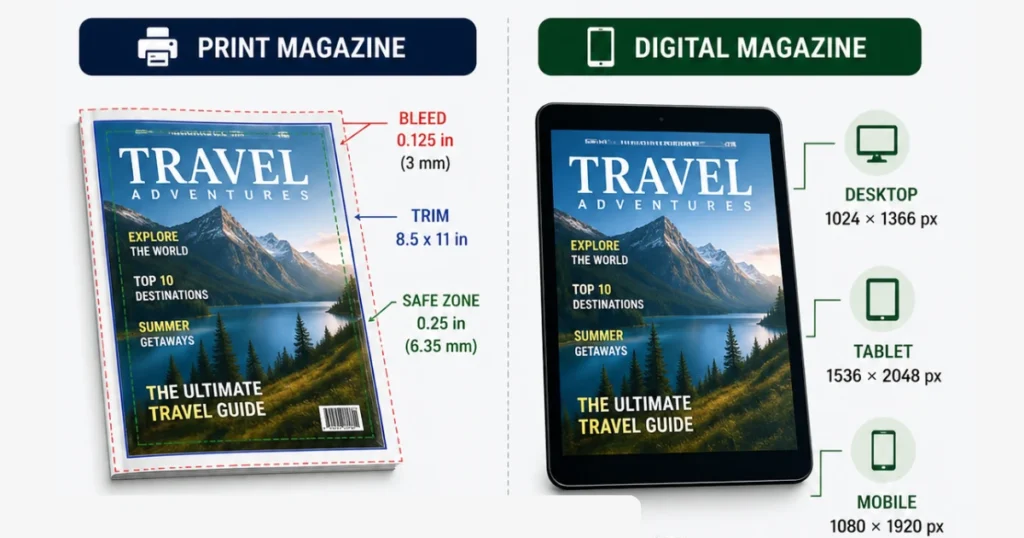
Print magazines require high-quality files, typically 300 DPI resolution with CMYK color mode to ensure sharp images and accurate printed colors.
Digital magazines use lower resolutions, usually 72–150 PPI, and rely on RGB color mode for accurate display on screens and mobile devices.
Print layouts need bleed and safe margins for trimming, while digital layouts focus on screen optimization and responsiveness across desktops, tablets, and smartphones.
| Platform | Resolution | Dimensions | Color Mode |
|---|---|---|---|
| 300 DPI | 8.5 × 11 in | CMYK | |
| Desktop | 72–150 PPI | 1024 × 1366 px | RGB |
| Tablet | 150 PPI | 1536 × 2048 px | RGB |
| Mobile | 72–150 PPI | 1080 × 1920 px | RGB |
Real-World Magazine Dimension Examples
Major publishers choose dimensions that match their specific content priorities — not just the cheapest or most common format.
- Vogue — 8 × 10.875 inches — optimized for vertical fashion photography with elegant proportions and premium newsstand presence
- Time Magazine — 8 × 10.75 inches — balances news content and full-color imagery for a versatile, mass-market reader experience
- National Geographic — 8 × 10.875 inches — showcases stunning full-bleed photography while maintaining a comfortable, manageable reading size
- Reader’s Digest — 5.5 × 8.5 inches — prioritizes portability and easy one-hand handling for commuters and on-the-go readers
- Entertainment Weekly — 11 × 17 inches — dramatic tabloid format built for bold headlines and full-spread photography
Frequently Asked Questions
What is the standard magazine size?
The most common magazine size is 8.5 × 11 inches (216 × 279 mm).
What size is a Vogue magazine?
Vogue is approximately 8 × 10.875 inches, slightly taller and narrower than standard letter size.
Are magazines A4 or A5 size?
Most US magazines use letter size, while many European publications use A4 or A5 formats.
How big is a digest-size magazine?
A digest magazine typically measures 5.5 × 8.5 inches (140 × 216 mm).
How do you measure magazine dimensions?
Measure the width first, then the height, from trim edge to trim edge.
What are oversized magazine dimensions?
Oversized magazines usually start at 9 × 12 inches and can be significantly larger.
What magazine size is best for photography?
Tabloid, oversized, and square formats are popular choices for photography-heavy publications.
Conclusion
Magazine dimensions shape everything — production costs, reader experience, newsstand presence, and market positioning. The standard 8.5 × 11 inch letter format dominates American publishing for one simple reason: it’s the most efficient, cost-effective, and reader-friendly size available.
Choose dimensions that match your content type, audience, and budget. Standard sizes save money. Specialized formats create premium positioning. Knowing every measurement in this guide puts you ahead of every publishing decision before a single page goes to print.

Hi, I’m John Smith, the admin at BedDimensionsChart.com. I make measurements simple and easy to understand, from bed sizes to everyday length conversions. Clear guides. Accurate dimensions. No confusion.