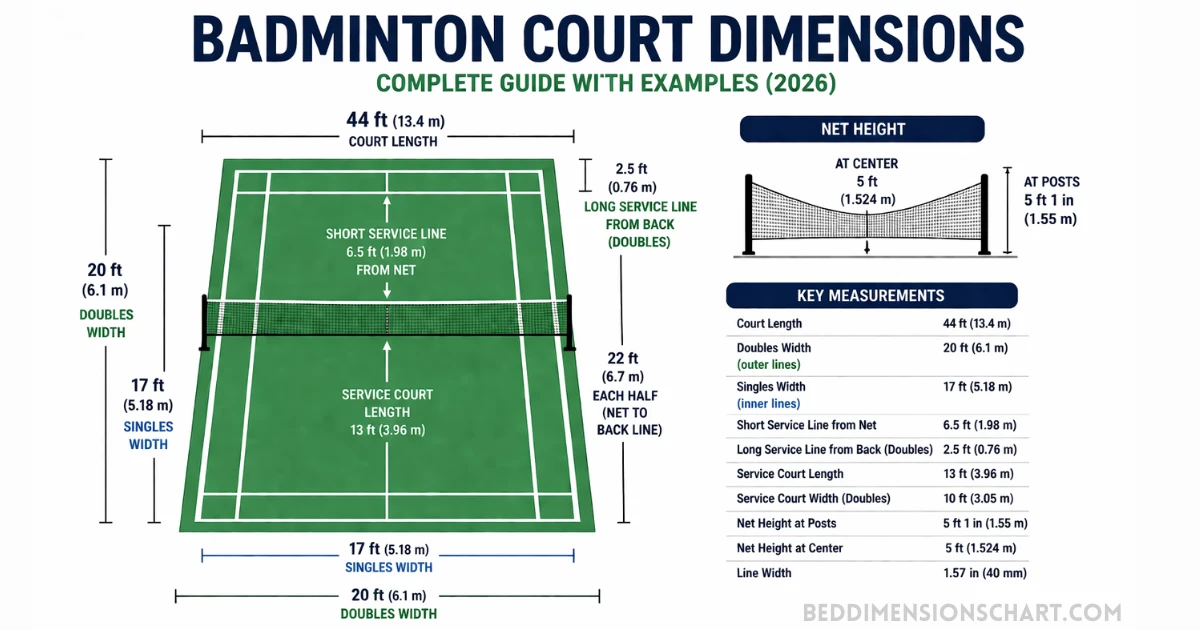
A standard badminton court measures 44 feet long and 20 feet wide, with the net set at an official height of 5 feet 1 inch at the posts. These dimensions are used worldwide, from recreational courts and school gyms to international tournaments and Olympic competition.
This guide covers all official badminton court measurements, including singles and doubles boundaries, net height, service areas, court markings, and dimension charts, helping players, coaches, and facility planners understand the game with confidence.
Badminton Court Size
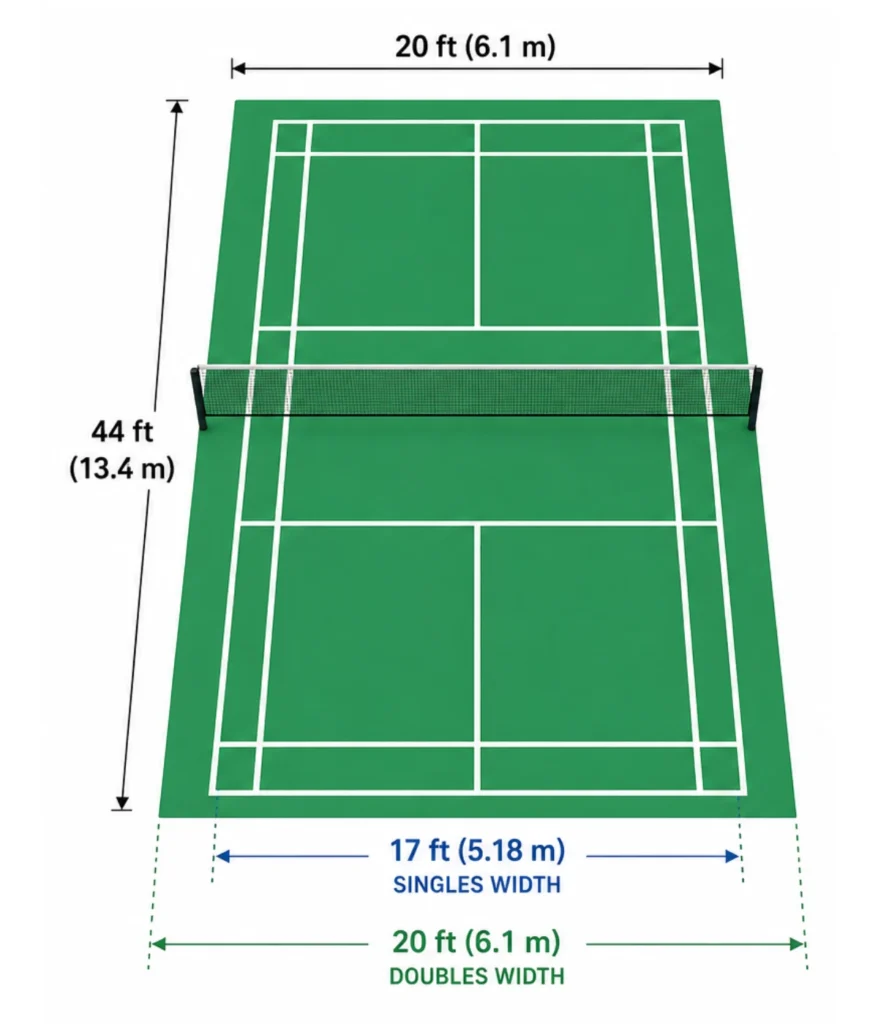
Court Length: 44 ft (13.4 m) for both singles and doubles.
Doubles Width: Uses the full court width of 20 ft (6.1 m).
Singles Width: Uses the inner sidelines, reducing the width to 17 ft (5.18 m).
The court length never changes—only the active playing width differs between singles and doubles.
| Format | Length | Width |
|---|---|---|
| Doubles | 44 ft (13.4 m) | 20 ft (6.1 m) |
| Singles | 44 ft (13.4 m) | 17 ft (5.18 m) |
| Total Court Area | 880 sq ft (doubles) / 748 sq ft (singles) | |
Standard Badminton Court Dimensions
The standard badminton court dimensions cover every marked zone on the playing surface. Each measurement has a specific purpose — service rules, boundary calls, and net play all depend on knowing exactly where each line falls.
Every measurement below is official per BWF international regulations used at the Olympics and World Championships.
| Dimension | Feet | Meters |
|---|---|---|
| Total Length | 44 ft | 13.4 m |
| Doubles Width | 20 ft | 6.1 m |
| Singles Width | 17 ft | 5.18 m |
| Short Service Line | 6.5 ft from net | 1.98 m |
| Long Service Line (Doubles) | 2.5 ft from back boundary | 0.76 m |
| Service Court Length | 13 ft | 3.96 m |
| Service Court Width | 10 ft (doubles) | 3.05 m |
| Net Height at Posts | 5 ft 1 in | 1.55 m |
| Net Height at Center | 5 ft | 1.524 m |
| Line Width | 1.57 inches | 40 mm |
Important note on line width: All court lines are 40 mm (1.57 inches) wide and are considered part of the court boundary they define. A shuttle landing on any line is ruled in.
Badminton Court Size In Feet
For players building or marking a court, working in feet is the most practical unit in the USA. Badminton court size in feet broken into every measurable zone.
The full court spans 44 feet end to end. Each half measures 22 feet from the net to the back boundary line. The short service line sits 6.5 feet from the net on each side — creating the non-volley service zone directly in front of the net.
| Zone | Measurement (Feet) |
|---|---|
| Full Court Length | 44 ft |
| Each Half (net to back line) | 22 ft |
| Short Service Line from Net | 6.5 ft |
| Long Service Line from Back (Doubles) | 2.5 ft |
| Doubles Width | 20 ft |
| Singles Width | 17 ft |
| Center Line (splits service courts) | 22 ft long |
Badminton Court Measurement
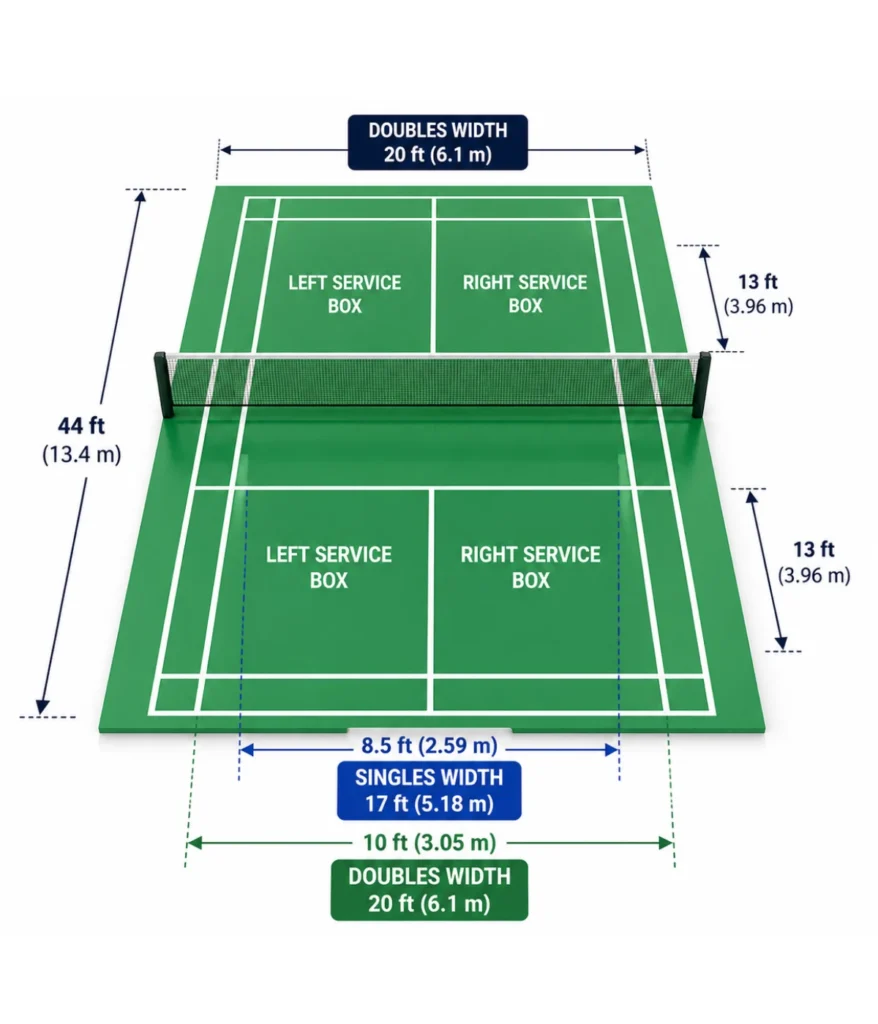
The badminton court measurement system divides the court into four equal service boxes — two on each side of the net. Each service box measures 13 feet long and 10 feet wide for doubles, or 13 feet long and 8.5 feet wide for singles.
These service boxes determine where legal serves must land. In singles, the serve must land between the short service line and the back boundary line — inside the opposite diagonal box. In doubles, the serve must land short of the long service line, which sits 2.5 feet inside the back boundary.
Badminton Court Measurements In Feet
Here’s a single consolidated reference for every badminton court measurement in feet — useful for construction, marking, and coaching.
| Measurement | In Feet | In Meters |
|---|---|---|
| Court Length | 44 ft | 13.4 m |
| Doubles Width | 20 ft | 6.1 m |
| Singles Width | 17 ft | 5.18 m |
| Net to Short Service Line | 6.5 ft | 1.98 m |
| Back Boundary to Doubles Long Service Line | 2.5 ft | 0.76 m |
| Net Post Height | 5 ft 1 in | 1.55 m |
| Net Center Height | 5 ft | 1.524 m |
| Recommended Clearance Around Court | 4 ft minimum | 1.22 m |
| Recreational Ceiling Height | 20 ft | 6.1 m |
| Competition Ceiling Height | 30 ft | 9.1 m |
Badminton Court Lines
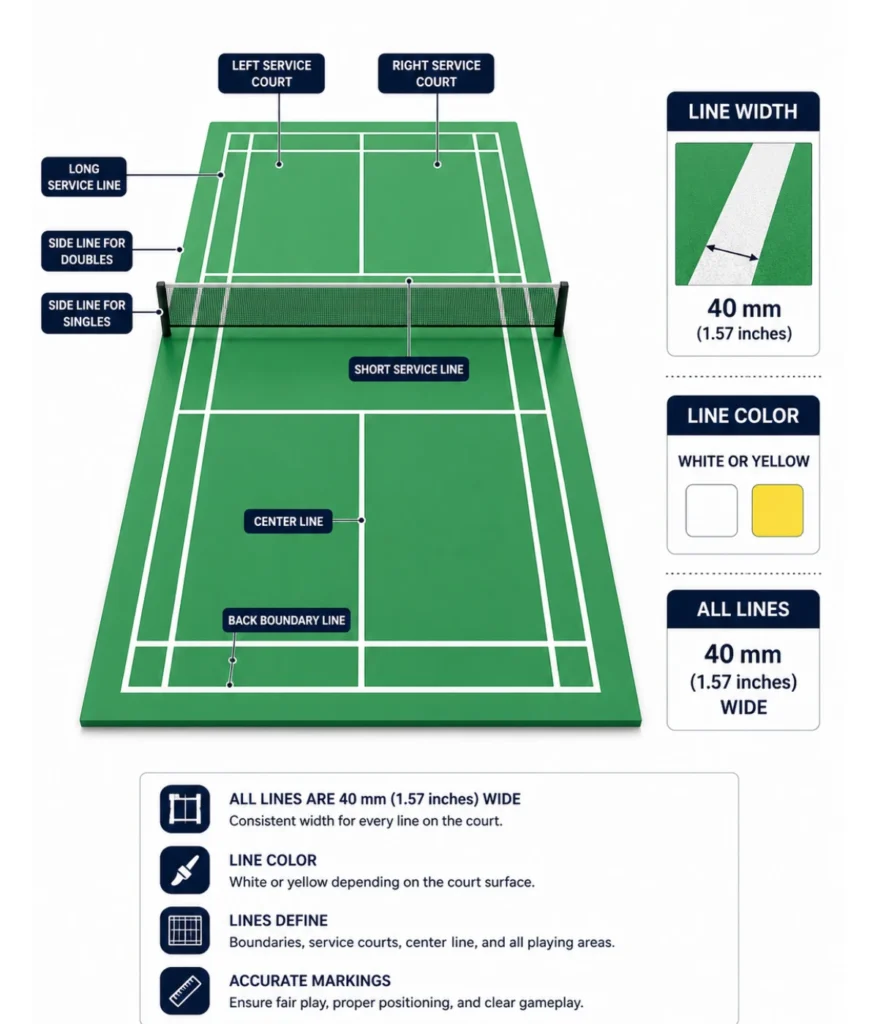
Badminton court lines define every boundary, service zone, and playing area on the court. Every line is 40 mm (1.57 inches) wide, painted or taped in white or yellow depending on the surface color.
There are eight distinct lines on a standard badminton court. Understanding each one eliminates boundary disputes and service faults during competitive play.
| Line Name | Purpose |
|---|---|
| Back Boundary Line | Outermost end line — used for singles long service and rally boundaries |
| Long Service Line (Doubles) | 2.5 ft inside back boundary — limits doubles serve depth |
| Short Service Line | 6.5 ft from net — serves must clear this line |
| Center Line | Divides left and right service courts from net to short service line |
| Side Line (Doubles) | Outermost side boundary — full 20 ft width |
| Side Line (Singles) | Inner side boundary — 17 ft width |
| Net Line | Marks the net position across the court center |
| Mid-Court Line | Divides the court into two equal halves lengthwise |
Single Badminton Court Lines
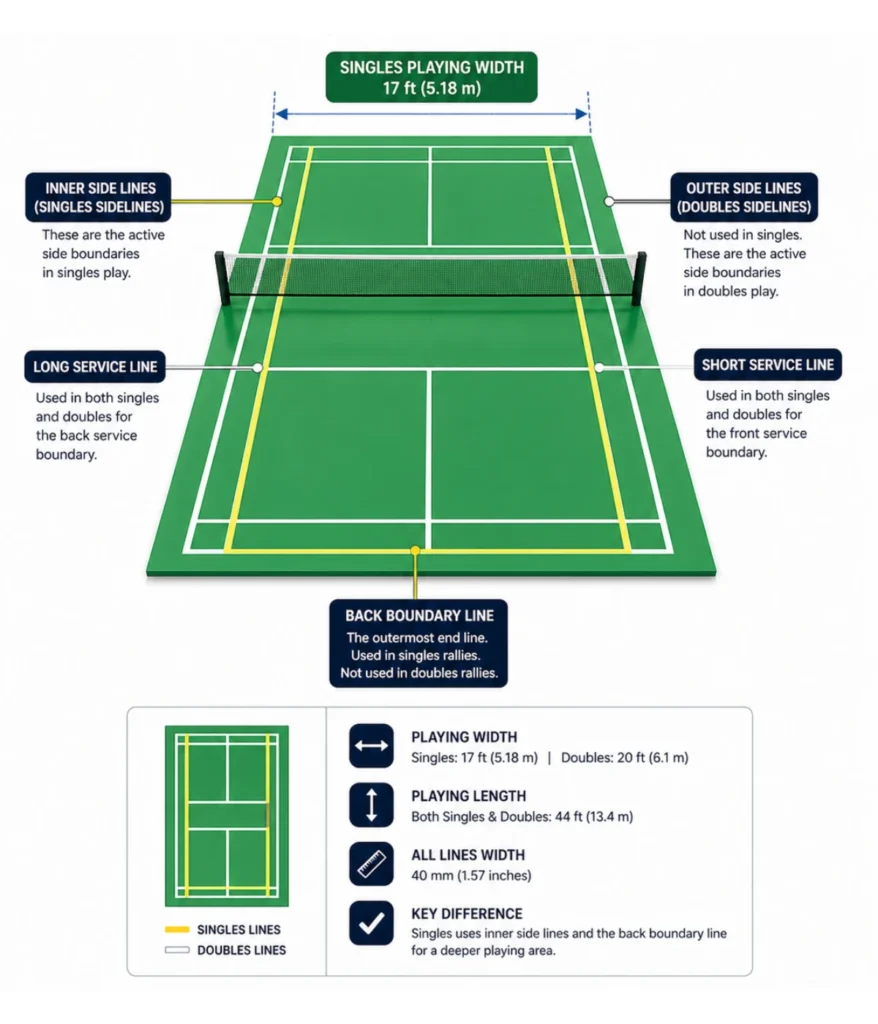
Singles badminton uses different boundary lines than doubles — even though both formats play on the same physical court. In singles, the inner side lines become the active boundaries, reducing the playing width to 17 feet (5.18 m).
The back boundary line — the outermost end line — is used for singles in rallies, giving the singles court a longer effective service depth than doubles. In doubles, the long service line sits 2.5 feet short of that back boundary, making the service zone slightly smaller.
Singles-specific line rules at a glance:
- Side boundary: inner side lines (17 ft width)
- Back boundary during serve and rally: back boundary line (full depth)
- Short service line: same as doubles — 6.5 ft from net
Badminton Net Height
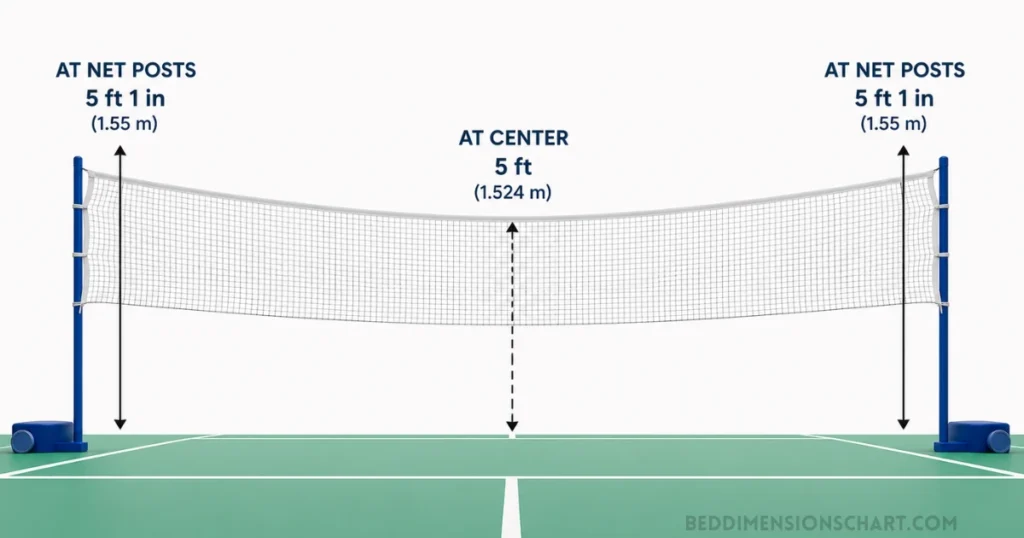
The badminton net height is not uniform across the full width — it is deliberately higher at the posts than at the center. This slight droop is intentional and regulated.
At the net posts, the net stands 5 feet 1 inch (1.55 meters) tall. At the center of the court, it sags to exactly 5 feet (1.524 meters). That 1-inch difference is built into every regulation net under BWF standards.
| Net Position | Height (ft/in) | Height (meters) |
|---|---|---|
| At Posts | 5 ft 1 in | 1.55 m |
| At Center | 5 ft 0 in | 1.524 m |
| Net Width | Spans full 20 ft / 6.1 m | |
| Net Depth | ~2.5 ft / 0.76 m | |
The net posts must be placed on the doubles side lines — even during singles play. Posts positioned inside the court to match singles width are not BWF-compliant for official competition.
Badminton Ground Dimensions
Badminton ground dimensions refer to the total floor space required — not just the court itself, but the recommended clearance zone around the perimeter. This is where most home and gym installations fall short.
The minimum recommended clearance around all four sides of a badminton court is 4 feet (1.22 meters). This gives players enough room to chase shuttles to the back boundary and side lines without hitting walls or equipment.
| Space Requirement | Measurement |
|---|---|
| Court Only (Doubles) | 44 × 20 ft (880 sq ft) |
| With Minimum Clearance | 52 × 28 ft (1,456 sq ft) |
| Recommended Total Space | 54 × 30 ft (1,620 sq ft) |
| Ceiling — Recreational | 20 ft (6.1 m) minimum |
| Ceiling — Competition | 30 ft (9.1 m) minimum |
For home installations, a space of at least 52 x 28 feet is the practical minimum. Anything smaller limits safe play near the boundaries. Competition venues typically allocate 54 x 30 feet or more per court.
Indoor Badminton Court Size vs Outdoor Badminton Court Size
Indoor and outdoor badminton courts share identical line dimensions — the court markings, net height, and service zones are exactly the same. The differences come down to surface, lighting, and environmental conditions.
| Factor | Indoor Court | Outdoor Court |
|---|---|---|
| Court Dimensions | 44 × 20 ft | 44 × 20 ft (identical) |
| Surface | Wood, synthetic, rubber | Concrete, asphalt, grass |
| Lighting | Controlled — no glare | Natural light — wind and glare factors |
| Net Posts | Fixed floor sockets | Ground stakes or weighted bases |
| Wind Effect | None | Significant — affects shuttle trajectory |
| Competition Use | All professional play | Recreational only |
| Ceiling Requirement | 20–30 ft minimum | No ceiling — open air |
All professional and Olympic badminton is played indoors — wind interference makes outdoor shuttle flight too unpredictable for competitive play. Recreational outdoor courts are common in parks and backyards, but serious players train exclusively on indoor wooden or synthetic surfaces.
The BWF prohibits outdoor courts for any sanctioned tournament or ranking event. Indoor play is non-negotiable at the competitive level.
Frequently Asked Questions
What are the official badminton court dimensions?
A standard badminton court measures 44 ft × 20 ft (13.4 m × 6.1 m) for doubles play.
What is the size of a singles badminton court?
A singles court is 44 ft long and 17 ft wide (13.4 m × 5.18 m).
How high is a badminton net?
The net is 5 ft 1 in (1.55 m) high at the posts and 5 ft (1.524 m) high at the center.
How much space is needed for a badminton court?
A minimum area of 52 × 28 ft (15.8 × 8.5 m) is recommended, including safety clearance around the court.
What scoring system is used in badminton?
Modern badminton uses rally scoring to 21 points, with a two-point lead required to win.
Conclusion
Badminton court dimensions are precise and non-negotiable at the competitive level — 44 feet long, 20 feet wide for doubles, 17 feet for singles, with a net dropping from 5 ft 1 in at the posts to 5 ft at center.
Whether you’re marking a recreational court, coaching beginners, or planning a competition venue — these measurements give you everything you need. Every line, every zone, and every clearance requirement in one complete reference.

Hi, I’m John Smith, the admin at BedDimensionsChart.com. I make measurements simple and easy to understand, from bed sizes to everyday length conversions. Clear guides. Accurate dimensions. No confusion.