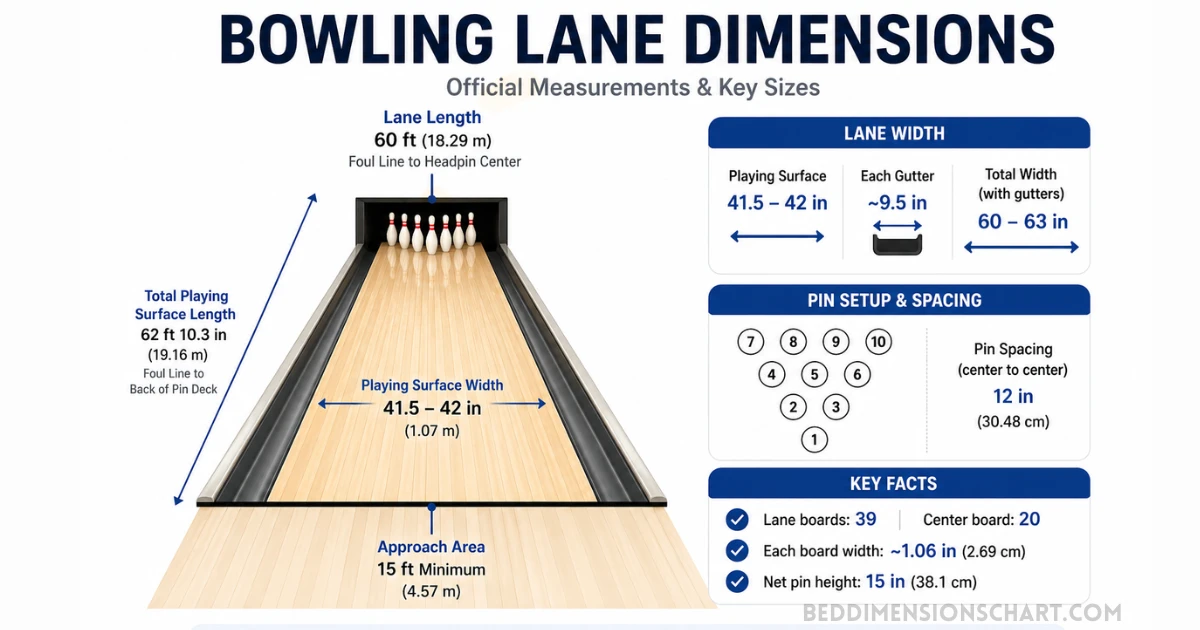
A regulation bowling lane measures exactly 60 feet (18.29 m) from the foul line to the center of the headpin. The playing surface runs 41.5 to 42 inches wide and consists of 39 individual boards. Add the gutters and the total width stretches to approximately 60 to 63 inches.
This guide covers every bowling lane dimension — length, width, pin spacing, approach area, and total building footprint — in one complete reference.
How Long Is A Bowling Lane?
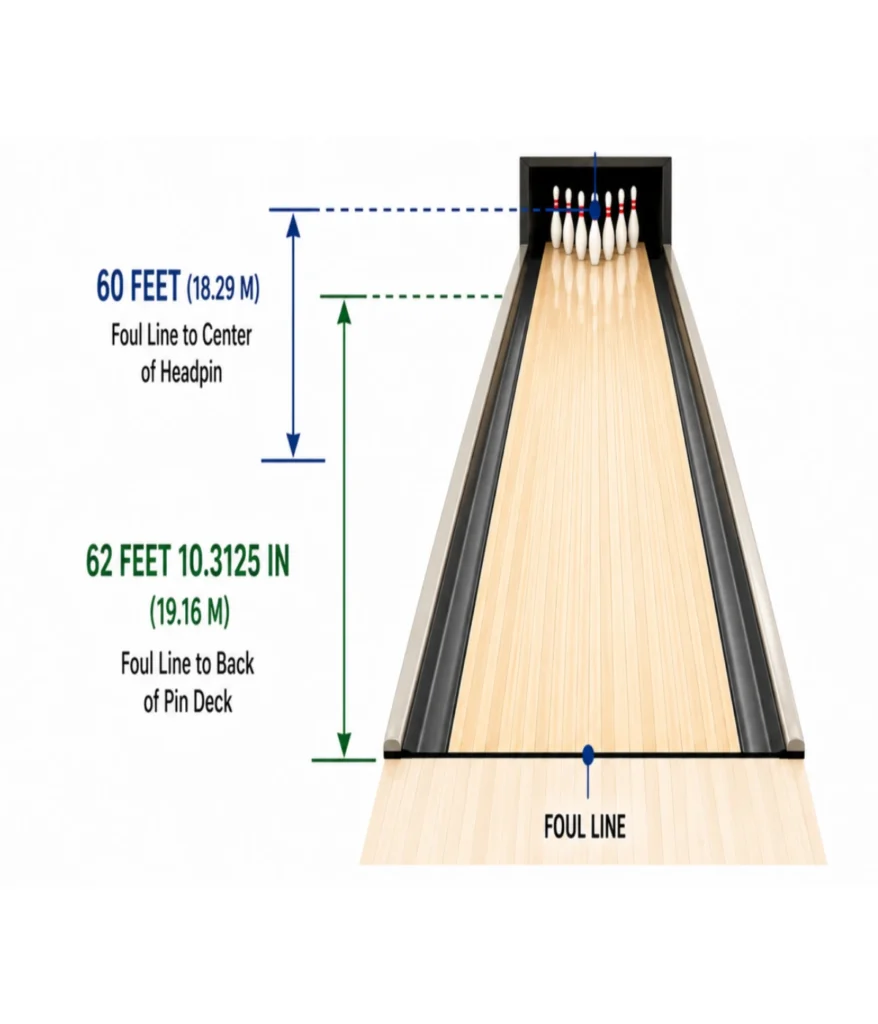
The official bowling lane length is 60 feet (18.29 m) — measured from the foul line to the center of the headpin. But the total playing surface from foul line to the back of the pin deck extends even further to 62 feet 10.3125 inches.
That extra nearly 3 feet accounts for the pin deck — the raised platform where all 10 pins sit. Behind the pin deck sits the backstop and pin-setting machinery, adding several more feet to the total room footprint.
| Measurement | Feet | Meters |
|---|---|---|
| Foul Line to Headpin Center | 60 ft | 18.29 m |
| Foul Line to Back of Pin Deck | 62 ft 10.3 in | 19.16 m |
| Approach Area (minimum) | 15 ft | 4.57 m |
| Total Lane + Approach | ~75 ft | ~22.86 m |
| Full Building Length (typical) | 90–100 ft | 27.4–30.5 m |
The 15-foot approach area behind the foul line is the minimum required under USBC (United States Bowling Congress) regulations. Most commercial alleys build approaches of 16 to 17 feet to give bowlers extra run-up room.
Standard Bowling Lane Dimensions
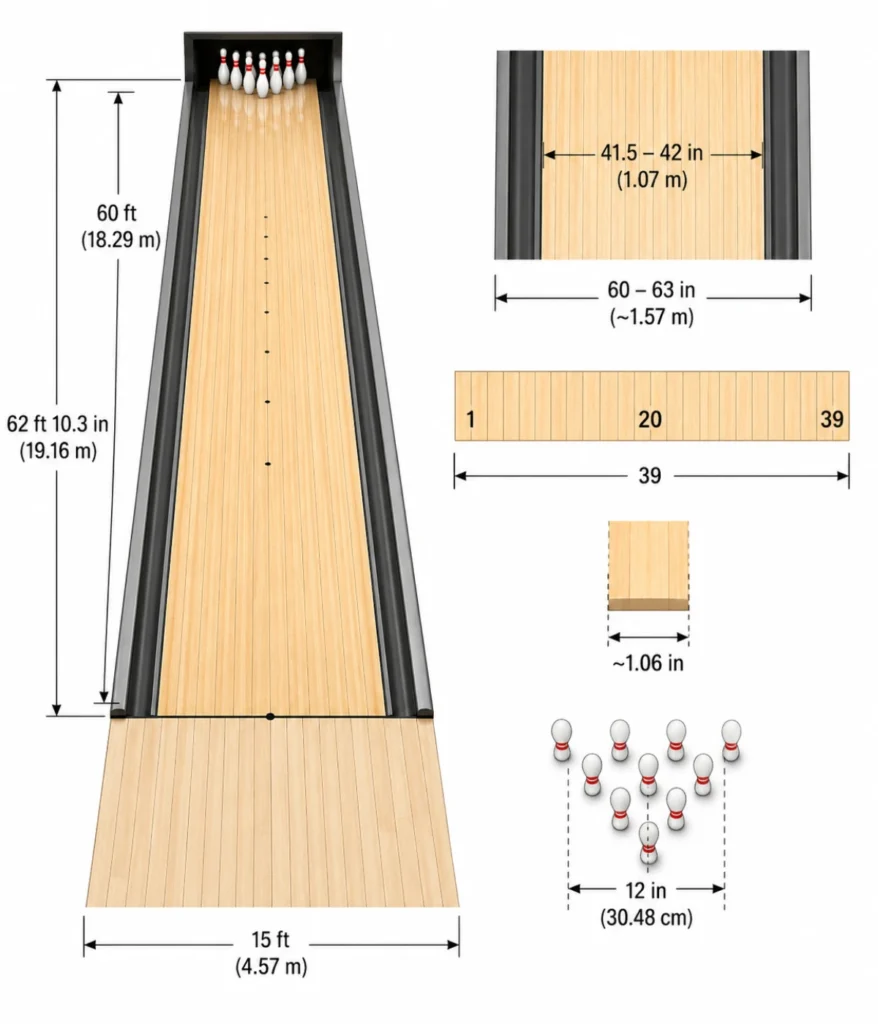
A regulation bowling lane follows strict USBC specifications at every measurement point. No dimension is arbitrary — each one affects ball roll, pin action, and competitive fairness.
The 39-board layout is one of the most important structural details. Each board is approximately 1.06 inches wide, and board 20 marks the exact center of the lane. Bowlers use board numbers as targeting references — aiming at specific boards rather than the pins themselves.
| Dimension | Measurement |
|---|---|
| Lane Length (foul to headpin) | 60 ft (18.29 m) |
| Total Playing Surface Length | 62 ft 10.3 in (19.16 m) |
| Lane Width (playing surface) | 41.5 – 42 inches (1.07 m) |
| Total Width Including Gutters | 60 – 63 inches (~1.57 m) |
| Number of Boards | 39 boards |
| Center Board | Board 20 |
| Each Board Width | ~1.06 inches |
| Approach Length | 15 ft minimum (4.57 m) |
| Pin Spacing (center to center) | 12 inches (30.48 cm) |
Bowling Lane Dimensions Chart
Here’s the complete bowling lane dimensions chart covering every zone from the approach area to the pin deck — the full reference every bowler, builder, and facility manager needs.
| Zone | Length | Width | Notes |
|---|---|---|---|
| Approach Area | 15 ft min | 41.5–42 in | Bowler run-up zone |
| Foul Line | — | Full lane width | Boundary line — toe must not cross |
| Heads (boards 1–15) | First 15 ft of lane | 41.5 in | Heaviest oil application zone |
| Midsection | 15–45 ft | 41.5 in | Transition zone |
| Back Ends | 45–60 ft | 41.5 in | Dry zone — hooks sharply here |
| Pin Deck | ~2 ft 10 in | 41.5 in | Raised platform holding 10 pins |
| Gutters (each side) | Full length | ~9.5 in each | Out-of-bounds channels |
| Total Width with Gutters | — | 60–63 in | Full lane structure width |
Lane oil pattern note: The first 15 feet (heads) receive the heaviest oil application. The back 15 feet (back ends) are left dry. This oil-to-dry transition is what causes a properly thrown ball to curve toward the pocket in the final third of the lane.
Bowling Lane Dimensions Diagram
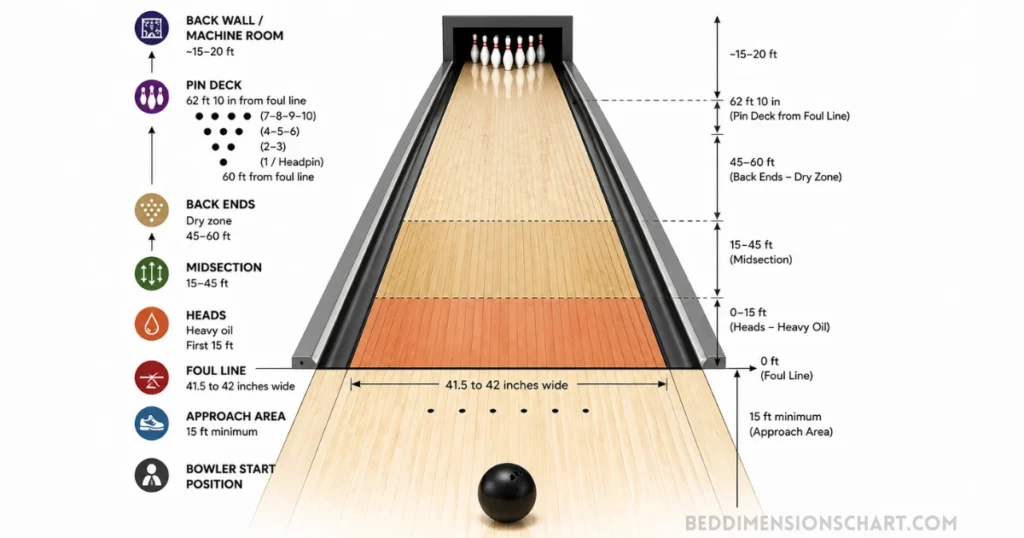
Here’s a structured breakdown of the bowling lane layout from back wall to pin deck — visualizing each zone in sequence.
Pin formation detail: All 10 pins form an equilateral triangle. Each pin sits 12 inches (30.48 cm) apart from its neighbors, measured center to center. The headpin (Pin 1) sits exactly 60 feet from the foul line. The back row of four pins (7, 8, 9, 10) sits at approximately 63 feet from the foul line.
Bowling Lane Width — Boards, Gutters, and Total Structure
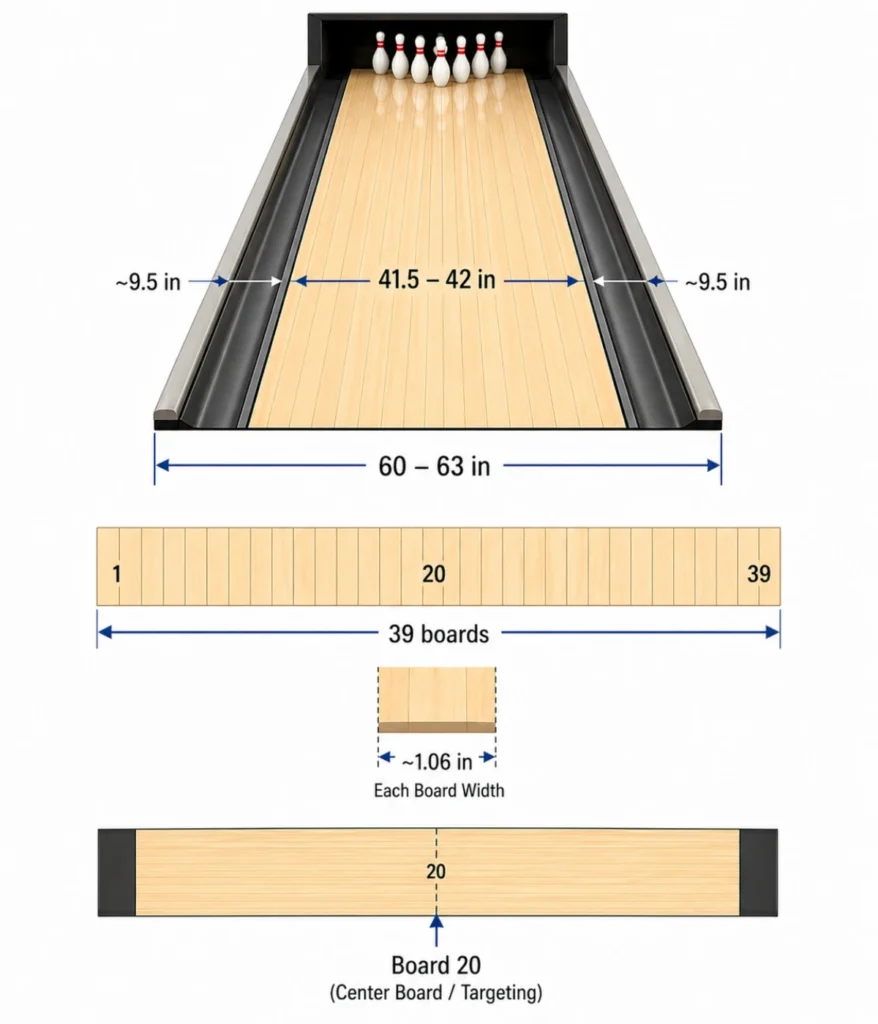
Bowling lane width involves three separate measurements that are commonly confused. The playing surface, the gutter width, and the total structural width are all different numbers.
The playing surface is 41.5 to 42 inches wide — the area where the ball legally rolls. Each side drops into a gutter (channel) approximately 9.5 inches wide. Add both gutters to the playing surface and the total structural width reaches 60 to 63 inches.
| Width Component | Measurement |
|---|---|
| Playing Surface | 41.5 – 42 inches |
| Each Gutter | ~9.5 inches |
| Total with Both Gutters | 60 – 63 inches |
| Number of Boards | 39 boards |
| Each Board Width | ~1.06 inches |
| Center Board (targeting) | Board 20 |
Why board numbers matter: Competitive bowlers target specific boards on the lane — not the pins directly. A bowler rolling over board 17 at the arrows (the targeting markers 15 feet past the foul line) is aiming for the pocket, not looking at the pins 60 feet away. Board 20 is center, boards 1–10 are the right side, and boards 30–39 are the left side.
Bowling Alley Dimensions — Full Building Footprint
A bowling alley is far larger than just the lane itself. The total building footprint includes seating, the approach area, the full lane, the pin deck, and the back machine room where pin-setting equipment operates.
| Space | Length | Notes |
|---|---|---|
| Seating + Concourse | ~15 ft | Varies by facility size |
| Approach Area | 15 ft min | USBC minimum requirement |
| Full Lane | 62 ft 10 in | Foul line to back of pin deck |
| Machine Room | ~10–15 ft | Pin setter and ball return machinery |
| Total Building Length | 90–100 ft | Typical commercial footprint |
For a home bowling lane installation, USBC recommends a minimum width of 11 feet 6 inches for two lanes side by side, with a total length of approximately 87 feet to accommodate approach, lane, and pin machinery.
Bowling Lane Surface and Materials
Bowling lane surfaces directly affect ball performance, speed, and hook. USBC approves two primary surface materials for regulation play — each with distinct performance characteristics.
| Surface Type | Material | Performance | Common Use |
|---|---|---|---|
| Wood | Hard maple (heads) + pine (back ends) | Classic hook response | Older commercial alleys |
| Synthetic | Urethane composite panels | Consistent, durable | Modern commercial alleys |
| Approach Surface | Rubber or synthetic | Non-slip traction | All facilities |
Hard maple is used in the first 15 feet (heads) because it withstands the highest ball impact zone. Pine is used in the midsection and back ends where the ball rolls rather than impacts. Most modern lanes use full synthetic overlays — easier to maintain, more consistent oil absorption, and longer lifespan than wood.
Frequently Asked Questions
What Is the Size of a Bowling Lane?
A regulation bowling lane measures 60 feet (18.29 m) long from the foul line to the headpin center, 41.5 to 42 inches wide, with a 15-foot minimum approach area. Total playing surface length is 62 feet 10.3 inches.
What Is the 3 6 9 Rule in Bowling?
The 3-6-9 spare system is a targeting method where bowlers adjust their starting position 3 boards right for a 6-pin spare, 6 boards for a 9-pin spare, and so on — while keeping the same delivery target at the arrows. It uses the board-based layout of the lane to create repeatable spare-shooting angles.
Are All Bowling Lanes 60 Feet?
Yes — all USBC-regulation bowling lanes are exactly 60 feet from the foul line to the center of the headpin. This measurement is non-negotiable for sanctioned league and tournament play. Recreational or mini-bowling setups may differ, but no official competition lane deviates from this standard.
Bowling Lane Dimensions in Feet?
A bowling lane measures 60 feet long and 3.5 feet (41.5–42 inches) wide. Including the approach, total lane space is approximately 75 feet. Full building length from seating to machine room typically runs 90 to 100 feet.
What Is the Exact Length and Width of a Bowling Lane?
The exact bowling lane length is 60 feet (18.29 m) from foul line to headpin. Total playing surface is 62 feet 10.3125 inches. The exact width is 41.5 to 42 inches (1.057 to 1.067 m), consisting of 39 boards each approximately 1.06 inches wide.
What Are Bowling Alley Dimensions?
A full bowling alley measures 90 to 100 feet in total length — including seating, approach, lane, and machine room. Width per lane including gutters is 60 to 63 inches. Commercial facilities typically allocate ~11.5 feet of width per lane pair.
How Long Is a Bowling Lane?
A bowling lane is 60 feet long from the foul line to the headpin — or 62 feet 10.3 inches to the back of the pin deck. With the approach area added, the total playing zone from bowler start to pin deck is approximately 75 to 77 feet.
Conclusion
Bowling lane dimensions are built on a single foundational measurement — 60 feet from foul line to headpin. Everything else — the 42-inch width, 39-board layout, 15-foot approach, and 12-inch pin spacing — is engineered around delivering a fair, consistent, and repeatable playing experience at every facility worldwide.
Whether you’re a bowler learning to target boards, a facility manager planning a build, or simply curious about the geometry of the sport — every measurement you need is right here.

Hi, I’m John Smith, the admin at BedDimensionsChart.com. I make measurements simple and easy to understand, from bed sizes to everyday length conversions. Clear guides. Accurate dimensions. No confusion.